
Former Rays Reliever Describes Arbitration Process
Ryan Thompson shows us what's really going on in the room, plus the latest on Ketel Marte and the team's television situation

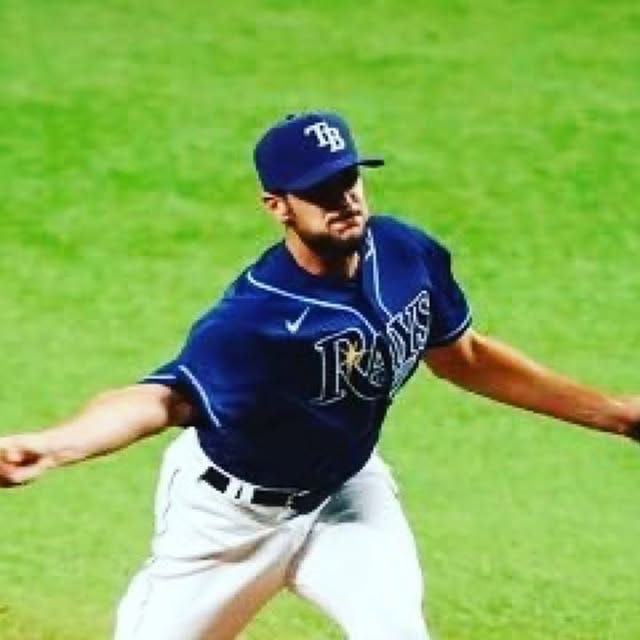
Word came out this week that nine of the ten arbitration-eligible players reached deals with the Rays before the deadline of going to arbitration. Only reliever Edwin Uceta did not come to an agreement with the team, and will take his chances before the panel. According to MLB.com’s Mark Feinsand, Uceta submitted that he should be paid $1.525 million, while the team countered with an offer of $1.2 million.
We’ve all heard the horror stories about what goes on in the conference room between the team and the player, and the aftermath that follows. I remember when pitcher Jake Odorizzi became the first player to defeat the Sternberg regime in arbitration, and subsequently get traded to the Minnesota Twins. Outfielder Corey Dickerson would follow not long after, winning his arb case and then getting dealt to the Pirates (though Dickerson obviously does not hold a grudge, as he was hired earlier this offseason to be the Rays’ new first base coach).
But a couple of years ago, Rays reliever Ryan Thompson pulled back the curtain on social media and showed exactly what happens when you go to arbitration.
In 2023, Thompson went to arbitration against the club. The right-hander was looking to get $1.2 million for the season, while the team countered at $1.025 million. The Rays ended up prevailing in the case, and Thompson would get the lesser salary.
“I want to make clear that although I lost my case, there is absolutely no ill-will towards the Rays as they were as professional and respectful as possible considering the circumstances,” Thompson said. “This is merely a review of the process.”
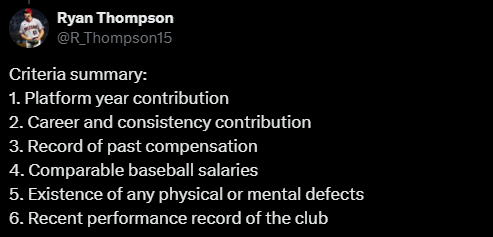
“Our approach to the hearing was to stay as strict to the criteria as possible. My concern was that the 3 arbitrators have an unknown knowledge of the game of baseball,” Thompson said. “We had to assume that the arbitrators were savvy enough to understand basic rules and statistics. I believe [now] that assumption was incorrect.”
Thompson said he and his representatives used different metrics than what the team used.
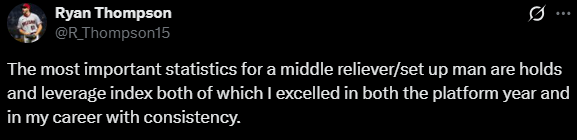
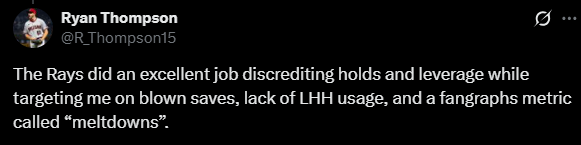
“Blown saves is not a stat indicative of a middle reliever's poor performance,” Thompson argued. “A blown save can happen with no earned runs in the 7th inning or in extra innings from the ghost runner scoring. [Blown Saves] are for those attempting to record a save and fail.”
Thompson also points out that while the Rays cited his lack of usage against left-handed hitters for why he shouldn’t get the amount he was arguing for, he said that lack came from what the team wanted out of him.
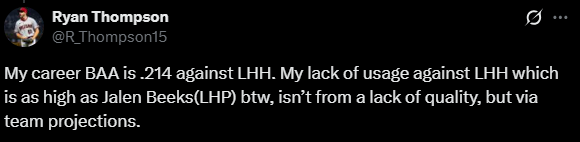
And as for the “meltdowns” metric used by the Rays, Thompson said that was a bit of an off-the-board surprise.
“Meltdowns is not an official MLB stat. I’ve never heard of it and maybe never will again,” Thompson said. “We could have scoured the web for positive terminology but stuck to the criteria.
“The use of ‘buzz words’ by the team without a doubt swayed the arbitrators. Blown saves, meltdowns, and ‘protected’ from LHH created a bias. Brilliant.”
Thompson pointed out a lot of flaws that he saw in the process, but did admit that he “really did have fun with it all.”
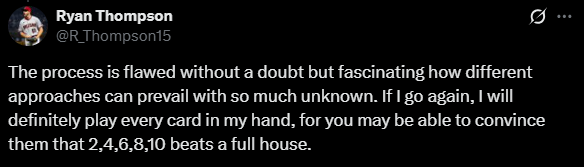
Uceta will get to find that out first-hand at some point this spring.
Marte Not Leaving The Desert
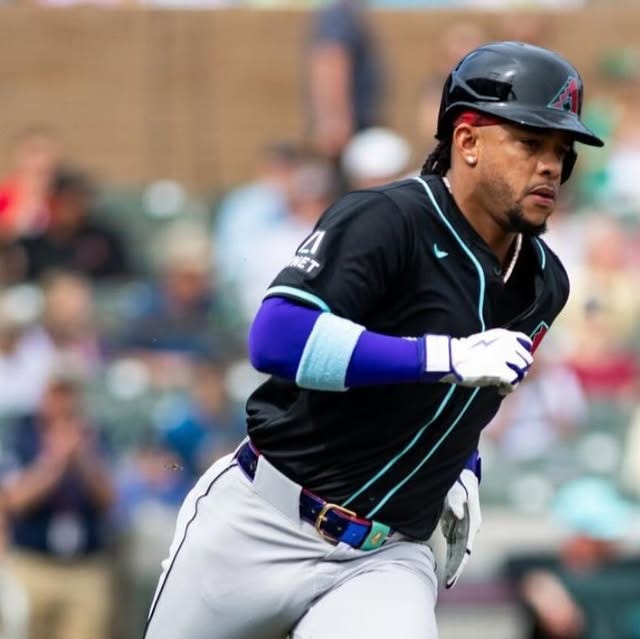
Any thought of the Tampa Bay Rays possibly bringing in Ketel Marte to replace Brandon Lowe at second base can now be scrapped, as the Diamondbacks second baseman will not be traded this off-season, according to Ken Rosenthal of The Athletic.
I had thought once the Rays had made a deal to trade Shane Baz to Baltimore, Tampa Bay would likely be very unwilling to part with the pitching and prospect capital that Diamondbacks GM Mike Hazen would have wanted in return for Marte, who has five years and $91 million remaining on his current contract.
So now Erik Neander and company will likely have to pivot to a different option if they want to upgrade from a possible second base platoon of Richie Palacios and Taylor Walls. One-time Rays minor-leaguer Luis Rengifo is still on the free-agent market, and is likely to remain there right up to the point that position players report to Spring Training. He is coming off a down year where he was injured, and could be the time of diamond in the rough play Tampa Bay is known for.
What’s Next For Rays TV Broadcasts?
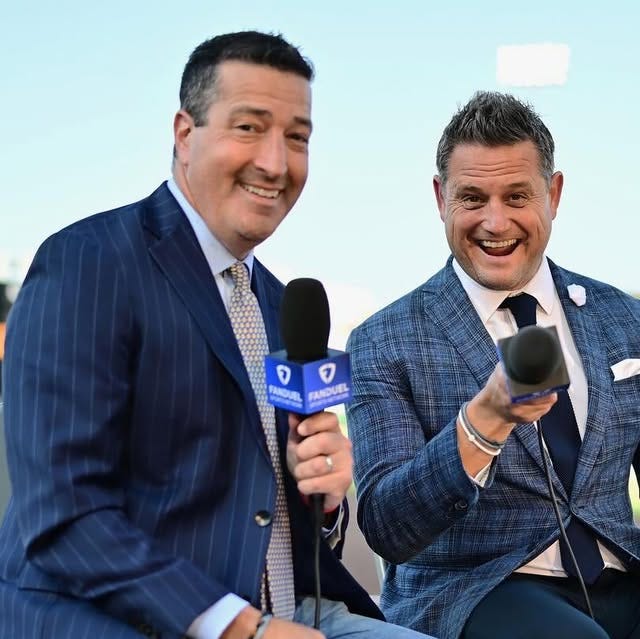
Thursday, the Rays became of one nine Major League Baseball teams to terminate their television contracts with Main Street Sports Group (the parent company of FanDuel Sports Network). This comes as Main Street reportedly missed rights payments to the St. Louis Cardinals and as many as 13 NBA teams they held broadcast rights to, and is in danger of closing down its operations if it can not find a buyer.
Thursday, MLB Commissioner Rob Manfred said the league is prepared and has the capacity to produce any and every team that has decided to walk away from Main Street, and fans do not need to worry about not being able to watch their team’s games on television.
“No matter what happens, whether it’s Main Street, a third party or MLB media, fans are going to have the games,” Manfred told The Associated Press.
So how would it work if MLB is running the Rays broadcasts?
First, you won’t have to worry about losing your favorite broadcasters. Major League Baseball has not made changes to broadcast teams in any other market they run (Arizona, Cleveland, Colorado, Minnesota, San Diego or Seattle), so you should have Dewayne Staats, Brian Anderson, Ryan Bass, Rich Hollenberg, Doug Waechter, etc. all back for 2026.
Second, the league will likely make a deal for a local television station to carry games. WTOG channel 44 (owned and operated by CBS) would appear to be the most likely landing spot, seeing as they showed 15 games last season and had an advertising sign at Steinbrenner Field last year.
Finally, expect a local in-market streaming package to be offered by MLB for Rays games, much like the other six teams received. That price would be in addition to the out-of-market MLB TV subscription service (which is now part of ESPN).